
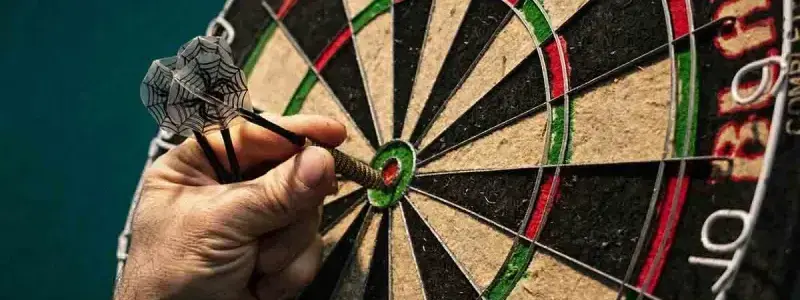
The Math Says You're Aiming at the Wrong Spot
Half an inch of drift is all it takes: the dart meant for treble 20 settles into the fat of the 5, and sixty points shrink to five. The board didn't just refuse the shot — it fined the thrower fifty-five points for trying.
That fine is by design. The dartboard is a piece of applied mathematics, and understanding its logic changes where you should aim.
A Board Built to Punish Greed
The number sequence — 20, 1, 18, 4, 13, and so on around the ring — isn't random. High numbers sit between low ones, so every rich target is bordered by poverty.
| Big number | Its neighbors | A near-miss costs you |
|---|---|---|
| 20 | 1 and 5 | The harshest on the board |
| 19 | 7 and 3 | Noticeably less |
| 18 | 4 and 1 | Nearly as much as the 20 |
The layout is often credited to a 19th-century craftsman, though its true origin stays murky. What's certain is the effect — it maximizes the cost of a near-miss, as explored in why the board is numbered the way it is.

- Built to official tournament specifications for serious practice and match play
- Dual-density core improves dart retention and keeps the board playing consistently
- Ultra-thin wiring increases the scoring area and cuts down on bounce-outs
Expected Value: The Only Stat You Need
Every aiming decision is an expected-value problem. Weigh each landing area by its points and by how often you actually hit it, and you get the true worth of aiming there.
For a professional, treble 20 dominates — they hit the treble so often that occasional visits to the 1 and 5 barely dent the average. For everyone else, the answer shifts with grouping size: the wider your darts scatter, the more the neighbors matter, and treble 20's neighbors are the worst on the board.
Where the Sweet Spot Moves as You Improve
Picture your accuracy as a cloud of darts centered on your aim point. The best target is wherever that cloud collects the most points, not wherever the single juiciest bed sits.
| Your grouping | Aim here | Why it wins |
|---|---|---|
| Tight — regular treble threat | Treble 20 | At your hit rate, the 1 and 5 barely matter |
| Medium | Treble 19 | Its neighbors, 7 and 3, punish misses far less |
| Wide — most beginners | The bull, or the 14–16 center-left region | A big scatter still averages respectable points |
That's the logic behind why players switch to the 19s. As your scatter grows, retreat from high-variance targets toward forgiving neighborhoods.
The Variance Trade-Off
Two targets with the same average can play very differently. Treble 20 is high-variance: visits of 26 and visits of 140 both happen.
Big singles are low-variance — steady, modest returns. When the leg is lopsided, variance itself becomes a weapon: a trailing player should gamble on trebles, while a leader can bank steady singles.
Doubles follow the same logic. Finishing from 32 beats finishing from 31 not because 32 is easier to hit, but because a miss into single 16 leaves another one-dart finish instead of an odd number.
Putting the Math to Work
You don't need equations at the oche — just three habits. They compress everything above into practical play.
- Know your grouping size. Throw 30 darts at treble 20 and honestly measure the spread.
- Pick the target your spread deserves. Ego says treble 20; expected value might say 19s or the fat singles.
- Leave even numbers. Route every finish toward 32, 40, or 24, as covered in broader dart strategies.
Is the bullseye the best target for beginners?
It's a reasonable one — aiming center means your scatter stays on the board almost every time. Some analyses prefer the lower-left region instead, since the 19, 16, and 7 cluster punishes misses gently.
Why not aim at treble 19 all the time?
If you hit trebles reliably, treble 20 is simply worth more per hit. The 19 only wins while your miss rate makes its friendlier neighbors matter.
Measure your spread this week, then let the number — not your ego — pick your target.