
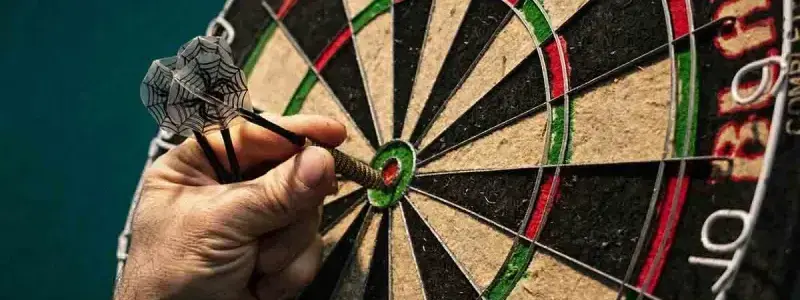
Darts Safety: Before the ER Visit, Read This
Halfway through your backswing, a blur of fur crosses the lane — the dog has found a dropped chip two feet in front of the board. Every home player has a near-miss story like this, and good darts safety is what keeps it a story instead of a vet visit.
Darts is a safe game built around a sharp object. A handful of layout decisions and house rules strip out almost all of the real risk.
Design the Room So Safety Is Automatic
The throwing lane — from the board back to a couple of feet behind the line — should never overlap a doorway, walking path, or play area. If people naturally cut through that strip of floor, the board's in the wrong place.
Put seating behind the thrower, never beside the board. Spectators drift toward the action, so give them somewhere better to be.
A dart backboard around the board earns its keep here too. It catches stray throws before they can bounce off the wall and skitter across the floor at ankle height.
House Rules That Actually Get Followed
Keep the list short enough that everyone remembers it:
- Nobody crosses the throw line while anyone is holding a dart.
- All three darts get thrown before anyone walks to the board.
- No throwing while a child or pet is anywhere in the room — lane rules or not.
- Darts are carried points-down, never tossed to a teammate.
- Bounce-outs stay where they land until the turn ends.
That second rule stops the most common accident in home darts: someone stepping in to pull darts while a third is still incoming. Call "darts away" or invent your own signal, but make approaching the board a deliberate act.
Kids Around the Board
Small children and steel-tip darts don't mix unsupervised, full stop. Store darts up high or locked away — never parked in the board, because a loaded bullseye at 5'8" is exactly eye-catching enough to tempt a climber.
A wall-mounted dartboard cabinet that closes over the board removes the temptation between sessions. When your kids are ready to actually play, magnetic boards and soft-tip setups let them join in safely — our guide to darts for kids covers the options.
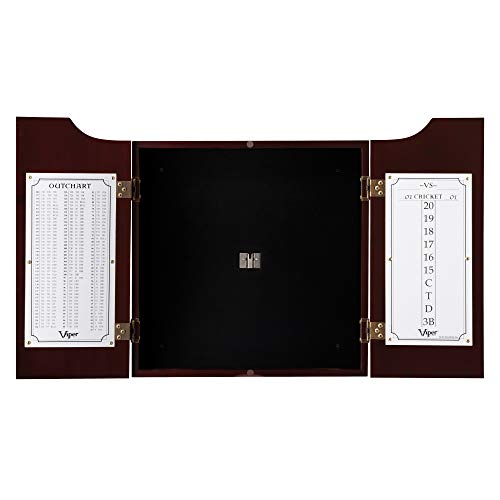
- Solid pine construction with box joints and bronze hinges is built to last
- Main compartment fits all official tournament-sized bristle dartboards
- Dry erase scoreboard and out-chart on the doors keep scoring close at hand
Once a kid is old enough to throw steel, teach the lane rules before the grip. Where to stand matters more than how to score.
Pets Around the Board
Pets can't learn oche etiquette, so layout and habit carry the whole load. A closed door during play is the single most reliable fix.
Bounce-outs are the pet-specific hazard: a dart on the floor reads as a chew toy to a dog and a swat toy to a cat. Pick up dropped darts the moment a turn ends, and count all three before play moves on.
Cats also can't resist dangling flights. Store darts in a case, drawer, or closed cabinet rather than a cup on an open shelf.
Storage and Shutdown Habits
Sharp, well-kept points are actually safer than damaged ones — burred tips cause more unpredictable bounce-outs. Check your points occasionally and retire anything bent.
End every session the same way: darts out of the board, counted, cased, cabinet shut. A consistent shutdown routine is what keeps a Tuesday-night hobby accident-free for years.
Quick Answers
Are bounce-outs really dangerous?
Mostly they're just annoying, but a dart ricocheting at floor level lands exactly where kids and pets live. A dart mat softens the bounce and visually marks the danger zone.
Are soft-tip darts completely safe?
Much lower risk, not zero — they're still weighted projectiles. Keep the same lane rules and you'll never have to find out where the line is.
Set the lane, post the rules, close the cabinet — then the sharpest thing in the room is the competition.
Darts for Kids: Safe Setup Parents Get Wrong
Lawn Darts: The Banned Classic, Played Safe