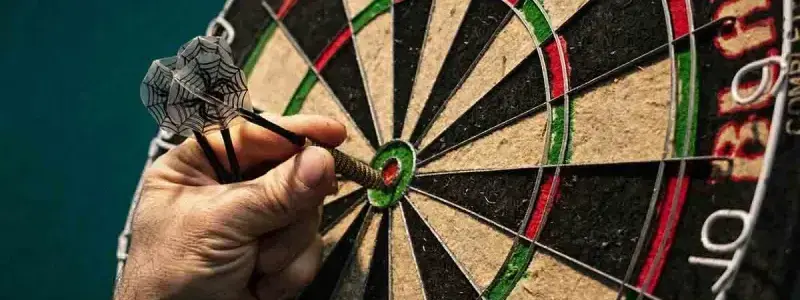
Darts Slang: Speak Like a League Veteran
Somewhere behind you at the pub board, a voice mutters "madhouse again" while another asks who Annie is and why she has a room. Darts talk can sound like a foreign language until someone hands you the dictionary.
This is that dictionary — every term you'll hear at the oche, alphabetical from Annie's Room to the Yorkshire board. Each one gets a plain-English definition and an example you can actually use.
A–B
- Annie's Room — old slang for a score of just 1, borrowed from wartime slang for a place nobody could ever find. "He needed 60 and visited Annie's room instead."
- Around the Clock — the classic practice game: hit 1 through 20 in order, then the bull. The standard board layout itself is nicknamed the clock. Miss the 7 and you'll be stuck on the 7 all night.
- Arrows — what players call the darts themselves. "Grab your arrows — you're up."
- Barrel — the metal body of the dart you actually grip, and the part that decides how it feels. Slim barrels leave room for three darts in one treble.
- Bed — any single scoring segment on the board. The treble 20 bed is about the size of a stick of gum.
- Bed and Breakfast — a score of 26, from hitting single 5, single 20, single 1. Named for the old price of a night's board and lodging: two and six. 5 + 20 + 1 = 26, the most common accident in darts.
- Bounce-Out — a dart that hits wire, refuses to stick, and drops to the floor. A bounce-out from dead centre of the treble still scores zero — the board owes you nothing.
- Bull / Bullseye — the red dot at dead centre, worth 50, with the green outer bull ring around it worth 25. The 50 counts as a double, so it can finish a leg on its own.
- Bust — in 01 games, scoring more than you have left (or leaving exactly 1), which cancels the whole turn. On 32, hit 40, and you're back on 32 like nothing happened — except everyone saw.
C–D
- Caller — the official who announces each score, ideally with operatic drama. "ONE HUNDRED AND EIGHTYYY!"
- Chalking — keeping score, a job named for the chalkboards pubs used before electronic scoring. Pub law: loser chalks the next game.
- Checkout — the combination that wins the leg, always ending on a double. On 40, the checkout is double top; on 170, it's treble 20, treble 20, bull.
- Chucker — a player who just lobs darts boardward with no aim and no shame. Every league has one chucker who somehow wins anyway.
- Cork — American for the bullseye, named after the cork bung in a beer barrel — the original target. "Closest to the cork throws first."
- Cricket — America's favourite bar game: close out 15 through 20 and the bull before your opponent does. Hit three 19s and the number is yours; extra 19s keep scoring until they close it too.
- Dartitis — the yips, darts edition: a mental block where your arm simply refuses to release the dart. Five-time world champion Eric Bristow battled dartitis for years.
- Diddle for the Middle — one dart each at the bull, closest throws first. Yes, that is really what it's called. "We diddled for the middle — her dart kissed the bull, so she's off."
- Double — the thin outer ring, worth twice the number. Games end here, and so do dreams. Double 16 = 32.
- Double In / Double Out — rules requiring a double to start scoring or to finish. Standard 501 is straight in, double out — nothing special to start, but you must end on a double.
- Double Top — double 20, the most famous finish in the game. "Forty left — he wants double top."
- Downstairs — the bottom half of the board, usually the 19s. "The 20 bed is blocked, so he's going downstairs for the treble 19."
F–I
- Flights — the wings at the back of the dart that keep it flying true. They're also the part your third dart loves to clip off. A wobbling dart usually means a torn or crooked flight.
- Game On — the caller's signal that the match has started and the chatter should stop. "Best of five legs — game on!"
- Game Shot — the call when the winning double lands. "Game shot, and the match!"
- Grouping — how tightly your three darts cluster together. Three darts you can cover with a coaster is proper grouping.
- Hat-Trick — three bullseyes in a single turn. 50 + 50 + 50 = 150 and a free round of applause.
- High Ton — a three-dart turn scoring 151 to 180. Hit 60, 60 and 45 and the caller announces a high ton of 165.
- Island — the scoring surface of the board itself. Miss it entirely and you're "off the island." His third dart left the island completely — a story for the drive home.
L–M
- Leg — one complete game, usually 501 down to a winning double. First to three legs takes the match.
- Low Ton — a three-dart turn scoring 100 to 150. 60 + 45 + 26 is a low ton of 131.
- Madhouse — double 1, where you land after whittling yourself down to 2. So named because it sends grown adults visibly insane. "Three visits stuck in the madhouse and he's started talking to himself."
- Married Man's Side — the left side of the board (14, 11, 9, 12, 8, 16), where nothing scores big but nothing punishes you either. Safe, sensible, and allegedly just like marriage. "He's playing the married man's side and grinding out 40s."
- Maximum — 180, three treble 20s, the perfect visit. 60 + 60 + 60 = 180, cue the caller losing his mind.
- Mugs Away — pub law: the loser of the last game throws first in the next one. A head start and an insult in the same breath. "Mugs away, mate."
N–R
- Nine-Darter — a perfect leg: 501 erased in nine darts, darts' answer to the hole-in-one. 180, 180, 141 is the classic route.
- Oche — the throw line, 7 feet 9¼ inches from the board in steel-tip play. Rhymes with "hockey." Toes on the oche, never over it.
- Right Church, Wrong Pew — the right number, the wrong bed. Aimed at treble 20, hit single 20: right church, wrong pew.
- Robin Hood — burying a dart into the back of one already in the board. Spectacular, legendary, and worth exactly zero. Photograph it, brag about it, score nothing for it.
S–T
- Set — a bundle of legs in longer formats. World Championship sets go to the first player to win three legs.
- Shanghai — single, double and treble of the same number in one visit. In the game named after it, a Shanghai wins instantly. 20 + 40 + 60 on the 20s is a 120 Shanghai.
- Slop — points scored while aiming somewhere else entirely. "I'll take it," he said, two beds from his target — slop counts the same as skill.
- Spider — the metal web of wires dividing the board into beds. Hit the spider square-on and the dart bounces out.
- Three in a Bed — all three darts in the same bed. Yes, that's the official term, and yes, the commentators enjoy saying it. Three darts in the treble 20 bed: three in a bed, 180.
- Ton — 100 scored in one visit; ton-forty is 140, ton-eighty is 180. "He's been throwing tons all night."
- Tops — another alias for double 20, sitting at the top of the board. "Standing on 40 — this is for tops."
- Treble — the thin inner ring, worth triple the number. The real money lives here. Treble 20 = 60, the highest-value bed on the board.
- Trombones — slang for a score of 76, straight out of the old song. "Seventy-six — trombones!"
- Tungsten — the dense metal serious darts are made from: denser metal, slimmer barrel, more room in the treble. 90% tungsten darts are around half the width of old brass ones.
W–Y
- Whitewash — losing a match without taking a single leg. Lose 4–0 and you've been whitewashed; the walk back from the oche has never felt longer.
- Wired — a miss so close it clipped the wire on the wrong side. The most honourable way to score nothing. "Wired for the nine-darter" is the cruelest sentence in darts.
- Yorkshire Board — a traditional board with no treble ring and no outer bull. No trebles means no 180 — a Yorkshire maximum is 120.
The Terms You'll Actually Need First
If you're new, you can survive a pub game knowing just a handful: leg, oche, bust, checkout, and double top. Everything else arrives on its own, usually attached to a story.

- Regulation compressed sisal surface heals around steel tips for a long playing life
- Rotating number ring spreads out wear to extend the board's lifespan
- Includes six steel tip darts so you can start playing right out of the box
The number-slang runs deepest in 01 games, where callers have nicknames for dozens of scores. Learning them is easiest while learning how scoring works in the first place.
What exactly is a "leg"?
One complete game, usually 501 straight down to a winning double. Everything bigger is just legs stacked together — first to three takes a pub match, and longer formats bundle legs into sets.
Why is the line called the "oche"?
Its origin is genuinely disputed, with theories ranging from old brewery names to Flemish words. Everyone agrees on the pronunciation, though — "OCK-ee," rhyming with "hockey."
How do you go "bust"?
Score more than you have left and the whole visit is wiped — you're back on the number you started with, pretending it never happened. Leaving exactly 1 also busts, because finishes must end on a double and the smallest double on the board is worth 2.
What counts as a "checkout"?
Any route from your current score to exactly zero, finishing on a double. Serious players memorise the standard routes from out-charts, topping out at 170 — treble 20, treble 20, bullseye — the famous "big fish."
Why "double top" for double 20?
Because the 20 sits at the very top of the board — the same logic behind its other nickname, "tops." It's the most requested finish in darts, since players deliberately steer their remaining score toward 40 just to end there.
What's a "ton" worth knowing about?
A ton just means 100 scored in one visit. Commentators shorten it constantly, so "ton-forty" is 140 and "ton-eighty" is the maximum.
Keep this page open during your next televised match and tick off each term as the commentators use it — you'll hear half the glossary inside an hour.