How to Aim Darts (You're Using the Wrong Eye)
Half an inch — that's how far the triple 20 seems to jump when you close one eye at the oche, then the other. Which eye you trust decides where your darts land all night.
Aiming isn't staring harder at the target. It's building one straight line from your dominant eye, through the dart, to the spot you want — and putting your body where that line can exist.
Find Your Dominant Eye First
Your brain favors one eye for judging position, and it's not always on the same side as your throwing hand. Two minutes settles it:
- Stretch both arms out and frame a small triangle between your hands.
- With both eyes open, center a distant object — a doorknob works — inside the triangle.
- Close one eye at a time. The eye that keeps the object centered is your dominant eye.
If you're right-handed and right-eye dominant (or left/left), aiming comes naturally. Cross-dominant players — right hand, left eye — need to turn the head or shift the stance slightly so the dominant eye gets behind the dart.
Build the Sight Line
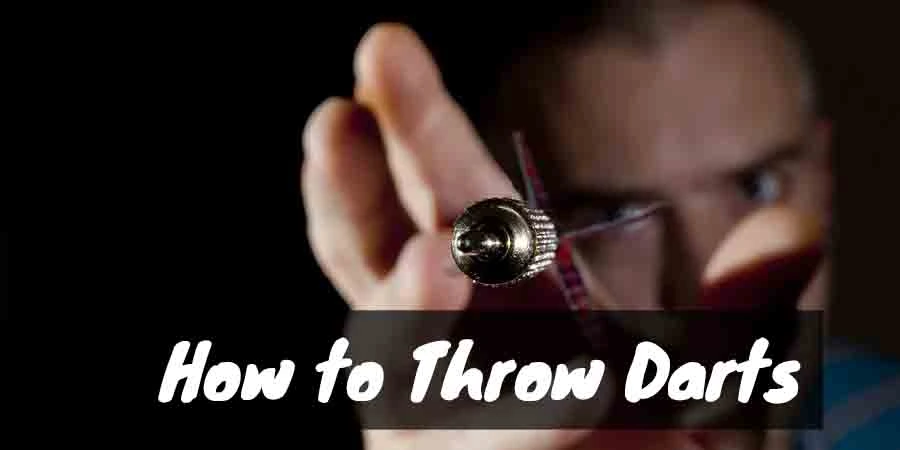
During setup, the dart should rise into your line of sight, not hang off to the side. Bring it up until the dart — some players sight off the tip, others the flight — sits just below your eye-to-target line.
The stack should read: dominant eye, dart, target. If your elbow drifts outward or the dart sits beside your face instead of in front of your eye, you're aiming down a bent line.
Keep both eyes open if you can. Closing one kills your depth perception, and most accomplished players sight with both eyes and let the dominant one do the work.
Alignment Starts at Your Feet
You can't aim down a line your own body blocks. Your stance should put your throwing shoulder, elbow, and eye roughly on the vertical plane that runs to the target.
For most players that means standing slightly off the center of the oche, so the arm's natural swing tracks straight at the 20. If every dart misses to the same side, move your feet an inch before you change anything about your arm — the fundamentals of throwing darts accurately all assume this line exists.
Aim Small, Miss Small
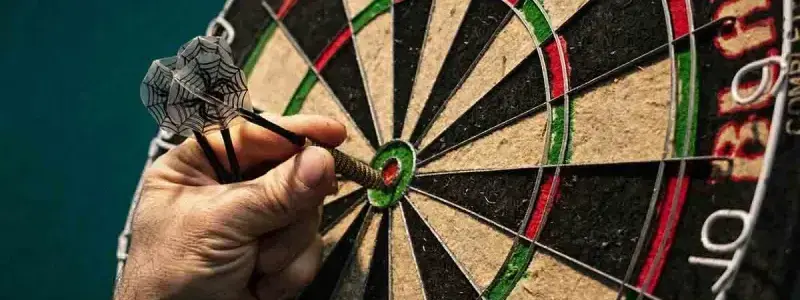
Don't aim at "the 20." Aim at a single stitch of sisal inside the triple bed, or a spot on the wire you want to just miss.
A small target shrinks your miss. Aim at the whole segment and your misses span the whole segment; aim at a point and your misses cluster around it.

- Built to official tournament specifications for serious practice and match play
- Dual-density core improves dart retention and keeps the board playing consistently
- Ultra-thin wiring increases the scoring area and cuts down on bounce-outs
Aiming Mistakes That Move Every Dart
- Sighting with the wrong eye, which shifts every dart a consistent half-inch to one side.
- Moving your head during the throw — the sight line dies the moment your eye moves.
- Aiming carefully with the first dart, then "feel-throwing" darts two and three.
- Chasing the previous dart instead of re-aiming at the target from scratch.
- Rushing the pause; give your eye a beat to lock the line before the arm moves.
Should the dart tip point at the target while aiming?
Slightly up and toward the target is typical, since the dart flies in an arc, not a laser line. What matters more is that the dart sits in your sight line the same way on every throw.
Why do I aim at the 20 and hit the 5 or 1?
That's horizontal drift: a bent sight line, a tilted head, or an elbow swinging out. Check eye dominance and alignment first — then work through why darts drift left or right for the release-side causes.
Do I aim differently for the bull than for the 20?
The process is identical; only the body line rotates a touch. If your bull is wildly worse than your 20, your "aim" on the 20 is probably memorized posture, not a real sight line.
Tonight, throw nine darts at one stitch in the triple 20 — aiming at a point instead of a segment is the whole skill.