Mickey Mouse Darts: Cricket's Wilder Cousin
Three tidy darts into the 15, and your teammate winces — you closed the 15s two rounds ago. In Mickey Mouse darts, reading the scoreboard is half the game.
Mickey Mouse is a cricket-style game with a bigger menu of targets. Instead of just 20 through 15 and bull, you're closing 20 all the way down to 12, plus dedicated lines for doubles, triples, and bulls.
What Is Mickey Mouse Darts?
Mickey Mouse plays like an expanded version of cricket darts, and some regions just call it "big cricket." The name comes from the long, ear-like column of numbers chalked on the scoreboard.
The targets are the numbers 20 down to 12, plus three special categories: doubles, triples, and bulls. That's twelve lines on the scoreboard instead of cricket's seven.
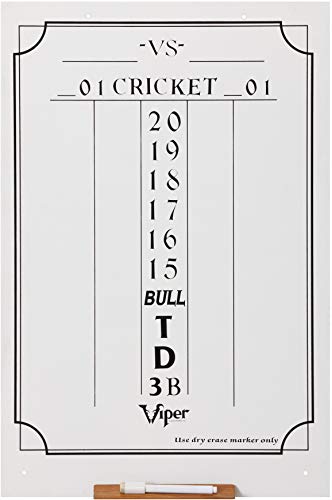
- Purpose-made layout tracks Cricket and 01 games at a glance
- Smooth surface works with any dry erase marker, and one comes included
- Mounting hardware is included for easy setup on a wall or cabinet door
Setup
- Works best with 2 players or 2 teams.
- Chalk the numbers 20 through 12 in a column, then add D (doubles), T (triples), and B (bulls) beneath them.
- Standard throwing distance applies: 7 feet 9.25 inches on a steel-tip board.
Each target needs three marks to close. A single is one mark, a double is two, and a triple is three — so one triple 18 closes the 18s instantly.
How to Play
Players alternate turns of three darts, working to close all twelve categories. You can attack the lines in any order, though most players work from 20 downward.
The special lines fill differently. Any double on the board earns one mark on the doubles line, any triple earns one on the triples line, and the bulls line takes three bull hits — with the inner bull counting as two.
Playing With Points
Like cricket, Mickey Mouse can be played with points. Once you've closed a number your opponent hasn't, further hits on it score its face value.
The game ends when one side has closed everything. In the points version, the side that closes all targets with equal or higher points wins.
Many casual games skip points entirely and just race to close all twelve lines. Decide before the first dart which version you're playing.
A Turn in Action
Dart one buries a triple 18 — the 18s close instantly. Dart two lands a single 20, putting your first mark on that line.
Dart three catches the outer bull for one mark on the bulls line. One visit, progress on three different lines — that's Mickey Mouse going well.
Strategy Basics
If you're playing with points, close the high numbers early — an open 20 in enemy hands bleeds 20 points a hit. The doubles and triples lines are where games are won, because they punish players who can only find fat singles.
Make your darts do double duty. A triple 17 can close your 17s outright, and once a number's closed, aiming triples at open numbers keeps feeding your triples line.
Behind on points? Stop closing, start scoring on your open numbers — and when you're ahead, race to close and lock the game down.
Common Mistakes
- Ignoring the doubles and triples lines until the end, then stalling while your opponent scores freely.
- Forgetting a triple counts three marks — players waste darts on numbers one good triple would've closed.
- Not agreeing on the points rule up front, which turns the final round into an argument.
- Losing track of the scoreboard — check what's still open before every turn.
How Is It Different From Cricket?
More targets: 20 down to 12 plus doubles, triples, and bulls, versus cricket's 20–15 and bull. Games run longer and reward a more complete skill set.
How Many Can Play?
Two players or two teams is standard. With a bigger crowd, split into teams — or pick a rotation game like Shanghai darts instead.
Is It Good for Beginners?
Yes — skip the points rule and just race to close. It teaches the whole board better than the more popular games that live and die on the 20.
Chalk up all twelve lines tonight and find out which half of the board you've been neglecting.