
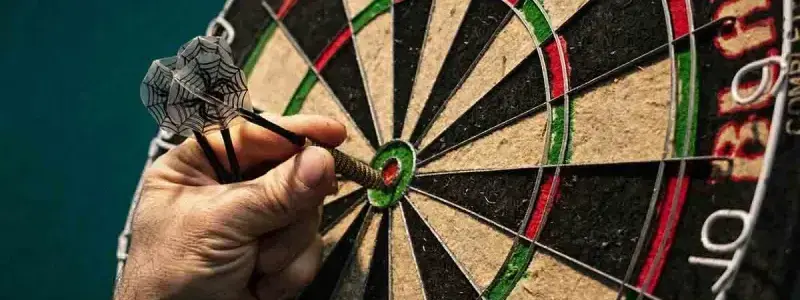
Left-Handed Darts in a Right-Handed World
Your mate hands over his darts and waves you up to the oche, and the whole room feels subtly backwards — the lighting, the scoreboard, even the worn patch where a thousand right-handed lead feet have landed. Playing darts left-handed isn't harder, but you're playing in a room quietly arranged for everyone else.
Does Throwing Left-Handed Hold You Back?
Not on the board itself. The dartboard is symmetrical from top to bottom through the 20, so no segment sits friendlier for either hand.
What does change is your stance, your sightline, and the setup around the oche. Sort those three out and the "lefty disadvantage" disappears completely.
Mirror the Stance — Don't Copy It
A right-hander leads with the right foot and turns the right shoulder toward the board. You flip the whole picture: left foot forward, left shoulder aimed at the target.
The classic beginner error is copying a right-handed friend's stance instead of mirroring it. Throw left-handed with your right foot forward and your shoulder swings across your body, dragging darts sideways.
Set up like this instead:
- Left foot at the line, angled comfortably toward the board
- Right foot trailing behind, carrying a small share of your weight
- Left shoulder, elbow, and eye stacked in one straight line to the target
The fundamentals in our guide to darts stance all still apply — just reversed.
Claim Your Own Spot on the Oche
Hardly anyone stands dead center on the throw line. Right-handers tend to drift left of center so the throwing arm lines up with the 20.
You'll probably want the mirror image: dead center or a touch right of it. Test a few positions over a couple of sessions, pick one, and plant yourself there on every visit — a consistent spot beats a "perfect" one.
The Quick Mirror Guide
| Right-handed habit | Left-handed mirror |
|---|---|
| Right foot forward at the line | Left foot forward at the line |
| Right shoulder turned to the board | Left shoulder turned to the board |
| Standing left of center on the oche | Standing at or slightly right of center |
| Arm, elbow, and right eye stacked | Arm, elbow, and left eye stacked |
Grip and Release Work Exactly the Same
Nothing about gripping a dart cares which hand you use. Hold the barrel at its center of gravity, use enough fingers for control, and stay relaxed.
The throw is just as hand-neutral — elbow up, smooth pendulum motion, clean follow-through. Your mechanics don't need special lefty treatment, just honest repetition.
Check the Room Before You Blame the Throw
Pubs and spare-room setups get built around the right-handed majority without anyone noticing. Run through this list before deciding your throw's the problem:
- Lighting mounted off to one side throws shadows across a lefty's sightline
- Scoreboards and chalkers hung left of the board sit right in your eyeline
- Cabinet doors that swing outward can crowd your throwing arm
Building a home setup? Mount your dartboard lighting straight-on rather than angled and most of these problems never appear.

- Three adjustable LED pods give a crisp, shadow-free view of the whole board
- Flips up out of the way so your dartboard cabinet still closes
- Runs off the included power adapter or 4 AA batteries for flexible placement
Mistakes Left-Handed Players Keep Making
- Copying a right-handed stance instead of mirroring it
- Standing where the right-handers stand purely out of habit
- Blaming loose grouping on being left-handed instead of on mechanics
- Switching hands mid-session and wiping out hard-earned muscle memory
Left-Handed Darts FAQ
Should I follow my dominant hand or my dominant eye?
Your dominant hand, always. If your dominant eye sits on the other side, tilt your head slightly at address instead of switching hands.
Are there special left-handed darts?
No. Darts are symmetrical, so any set works for either hand — barrel shape, weight, and grip texture matter, handedness doesn't.
Have left-handers succeeded as professionals?
Plenty of top players have thrown left-handed over the years. The board pays for a repeatable throw, not a particular hand.
Mirror the stance, mark your spot, and let the reps make the line forget which hand you throw with.