
501 Darts Rules: One Mistake Ends Your Leg
Forty left, one dart in hand, and the only target that matters is a sliver of board barely wider than your point. That's 501 — a race from a big number down to exactly zero, with a catch waiting at the finish line.
501 is the classic darts game, played in pubs and on professional stages around the world. The rules are easy to learn, but the finish demands real precision.
The Object of the Game
Every player starts with 501 points. Each turn you throw three darts, add up what they score, and subtract that total from your running score.
The first player to reach exactly zero wins. There's one big condition: the dart that brings you to zero must land in a double or the bullseye.
How Scoring Works
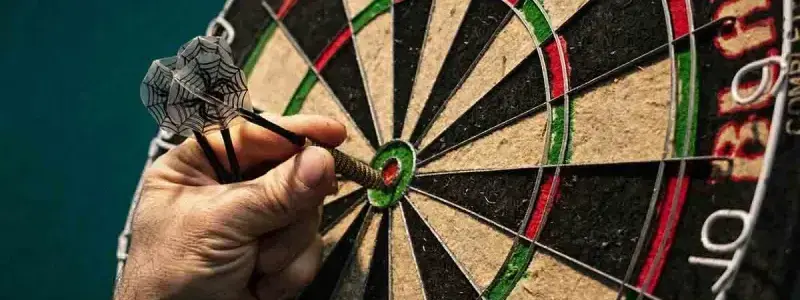
The board's numbered segments score their face value. The thin outer ring doubles a segment's score, and the thin inner ring trebles it.
The bullseye at the center scores 50, and the outer bull ring around it scores 25. That makes treble 20, worth 60, the biggest single-dart score on the board.
For a deeper breakdown of the math behind each visit, see how scoring works in 501 darts.
The Rules of a Turn
You get exactly three darts per turn — no more. If you throw a fourth by mistake, it simply doesn't count toward your score.
Only darts sticking in the board count. A dart that misses entirely, or falls out before it's scored, scores zero.
501 at a Glance
| Rule | Detail |
|---|---|
| Starting score | 501 points per player |
| Darts per turn | 3 |
| Winning shot | Exactly zero, finishing on a double or the bullseye |
| Bust | Going below zero, or landing on exactly 1 |
| After a bust | Score resets to the start of the turn; turn ends |
Finishing on a Double
You can't win 501 on a treble or a fat single, no matter how clean the shot looks. The final dart must land in a double or the bullseye.
That rule shapes the whole endgame. On 40 you aim double 20, and on 50 the bullseye takes you home.
Going Bust
Take your score below zero and you've gone bust. The same happens if you land on exactly 1, because the lowest double on the board is 2 and there's no way out from a single point.
A bust wipes out the entire turn. Your score resets to whatever it was before your first dart, and your turn ends on the spot.
A Worked Example
Say you're sitting on 100. You hit treble 20 for 60, single 20, and single 10 — a 90 visit that leaves you on 10.
Next turn, one dart in double 5 wins the game. A darts checkout chart shows the cleanest route to a double from any score you're left on.
What Darts Can You Use?
501 doesn't demand special equipment. Any darts are legal as long as each one is no longer than 30.5 cm and no heavier than 50 grams.
In practice, most players choose darts far lighter and shorter than those limits. Comfort and consistency matter more than the maximums.

- Regulation compressed sisal surface heals around steel tips for a long playing life
- Rotating number ring spreads out wear to extend the board's lifespan
- Includes six steel tip darts so you can start playing right out of the box
Why Strategy Beats Raw Accuracy
Hitting big trebles is only half the game. Good players think a turn ahead, steering their score toward a number they can kill with a double.
Even a player who out-scores you all leg can lose it at the finish. If you want to sharpen that side of your game, start with a proven 501 strategy.
Chalk up 501 tonight — and start planning your double two turns before you need it.