
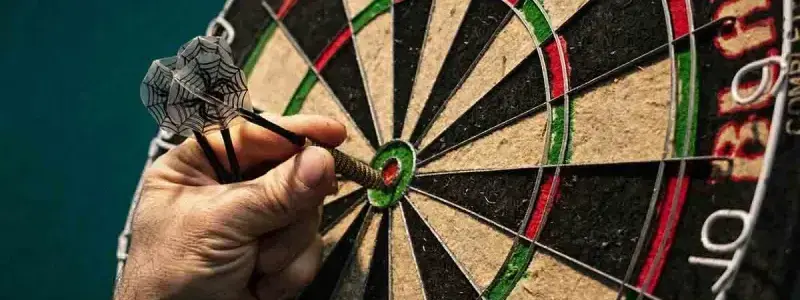
English Cricket Darts: Bat, Bowl, Battle
Somebody behind you mutters "bowl him out already" as your third dart skips off the wire, nowhere near the bull. Across the oche, the batter grins and chalks up another 47.
English cricket is a two-player darts game borrowed from the bat-and-ball sport, and it's a completely different animal from American cricket darts. One player bats for runs, the other bowls for wickets, then they swap.
What You Need
A standard board, three darts each, and a chalkboard tracking two things: the batter's runs and the wickets remaining. It's built for two players, though pairs can share the roles.
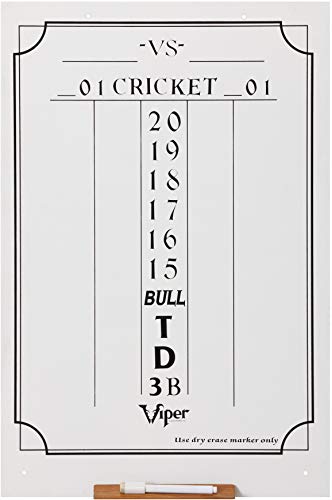
- Purpose-made layout tracks Cricket and 01 games at a glance
- Smooth surface works with any dry erase marker, and one comes included
- Mounting hardware is included for easy setup on a wall or cabinet door
The Rules
Decide who bats first — a throw at the bull settles it cleanly. The batter's job is to pile up runs; the bowler's job is to end the innings by taking wickets.
The batter starts with a set number of wickets, traditionally ten. Chalk ten strokes on the board and rub one off for each wicket that falls.
Batting
The batter throws three darts per turn at anything they like, usually the big trebles. The catch: only points above 40 in a turn count as runs.
Score 60 in a visit and you bank 20 runs. Score 38 and you bank nothing — steady 45s beat wild swings that miss.
Bowling
The bowler throws three darts per turn at the bullseye only. An outer bull takes one wicket, and an inner bull takes two.
When all ten wickets are gone, the innings is over. Swap roles, and the second batter chases the first batter's total.
Winning the Game
Whoever scores more runs in their batting innings wins. For a longer match, play two innings each and add the totals together.
A tie goes to a one-turn shootout or a rematch — chalker's choice, agreed in advance.
An Innings in Action
You bat first with ten strokes chalked up. Your opening visit lands 57, so 17 runs go on the board.
The bowler answers with an outer bull — nine wickets left. That's the whole game in miniature: your runs against their clock.
Strategy
For the Batter
Every turn under 41 points is a wasted visit, so treat 41 as your floor. Treble 20 is the run machine, but a safe pair of single 20s plus one treble attempt clears the bar with less risk.
Your scoring pace matters because the bulls will come. The treble work in how to accurately throw darts is exactly the batting skill this game tests.
For the Bowler
There's no shortcut — the bull is the only target, and hesitation doesn't shrink it. Groove one stroke, aim at the inner bull, and take the outer as a consolation wicket.
Bull practice here transfers straight to checkout pressure in games like 501 darts. Plenty of players quietly use English cricket as bull training with a scoreboard attached.
Common Variations
- Fewer wickets: five per innings keeps games short on busy boards.
- Team play: pairs alternate throws, one side batting while the other bowls.
- Bowler scoring: some house rules also subtract runs when the bowler hits bulls, but the standard game just removes wickets.
How Long Does a Game Take?
Two innings usually run 15 to 30 minutes, depending on how fast the bowler finds the bull. Cutting wickets to five roughly halves it.
Do Doubles and Trebles Matter for the Bowler?
No — for the bowler, only the two bull rings exist. Everything else on the board is a miss.
Chalk ten wickets, agree the over-40 rule out loud, and make the bowler earn every one.