
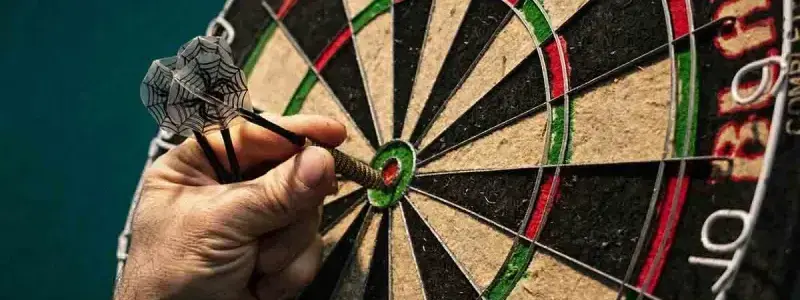
Outdoor Darts Setup: Boards Hate Weather
A gust rolls through mid-throw and the dart drifts a full ring right, ticking off the fence instead of the 20. Outdoor darts is a brilliant backyard game — once you outsmart wind, weather, and whatever sits behind the board.
A dartboard is happy outside for an afternoon and doomed if it lives there. Every good outdoor setup is built around that one fact.
Rule One: The Board Sleeps Indoors
Bristle boards are compressed sisal, and moisture is their enemy. Rain, dew, and even humidity swell the fibers, warp the board, and rust the wires.
Direct sun is nearly as bad — it dries and fades the sisal until it cracks. Hang the board for the session, then store it inside or in a weatherproof box, never out overnight.
Where to Hang It
You need a solid vertical surface with the bull at 5'8" and about 11 feet of flat ground in front of it. The usual candidates:
- A fence, with a mounting board screwed across two posts.
- A tree, with a flat mounting panel strapped or screwed on first.
- A shed or garage wall, or the inside frame of an open garage door.
- A freestanding dartboard stand — the most flexible pick for renters and patios.
Whatever you choose, the board can't move when a dart lands. Strap-mounted and hook-hung boards need a stiff backing panel to kill the sway.

- Surround catches stray darts before they can mark the wall behind the board
- Includes a regulation sisal bristle steel tip dartboard so you're ready to play
- High-density backboard also spares dart points from hard wall strikes
Level Ground and the Line
Grass and gravel hide sneaky slopes. Check that the thrower's feet and the ground under the board sit close to level, or scores will drift with the terrain.
Mark the oche at 7'9.25" with a stake, a paver, a plank, or spray chalk. The full measuring routine is in our height and distance guide.
Wind and Light
Wind pushes darts harder than anyone expects, and light darts with big flights suffer most. On breezy days, heavier darts with smaller flights fly noticeably straighter.
Aim the lane so nobody throws into a low sun. For evening legs, a clip-on light or a couple of well-aimed spotlights extends the session past dusk.
Downrange Safety
Outdoors, misses travel far and land where kids and pets roam. Set the board in front of a fence, hedge, or wall — never with open yard behind it — and keep spectators behind the thrower, not lounging beside the board.
A sheet of plywood or an old door behind the board catches strays and spares the fence. Steel points vanish in grass, so count your darts back before anyone walks downrange.
Or Skip the Board Entirely
If a regulation lane outside sounds like work, purpose-built outdoor games drop the wall altogether. Lawn darts throws big soft-tipped darts at ground rings, and beer darts is the classic camp-chair party game.
Both need nothing but open grass and basic safety sense. They're the smarter pick for a chaotic barbecue where a fixed throwing lane won't survive.
Quick Checklist
- Solid mount, bull at 5'8", ground level at both ends.
- Oche marked at 7'9.25", lane clear and downrange empty.
- Backing panel behind the board; heavier darts when it's breezy.
- Board comes inside after every session.
Hang it in the shade, and when the last leg ends, the board walks in with you.
Lawn Darts: The Banned Classic, Played Safe
Beer Darts: The Backyard Game of Legends