
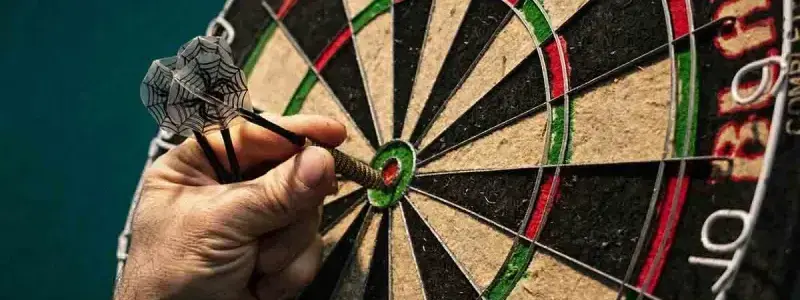
301 Darts: The Short Game With Sharp Teeth
Sixty points, wasted — your first two darts sat fat in the 20 before anyone reminded you that nothing counts until you've hit a double. That one rule is the whole personality of 301.
301 is the shorter, sharper cousin of 501. You start with 301 points, subtract everything you score, and race your opponent to exactly zero.
The Basic Rules
Each player starts on 301 and throws three darts per turn. Your turn total comes off your score.
The classic version adds one big catch: you must "double in." Until you land a dart in any double — the thin outer ring, or the bullseye's inner circle — none of your darts count.
Finishing has the same lock on the door: you must "double out." Your final dart has to land in a double that brings you to exactly zero.
What Counts as a Bust
Score more points than you have left and that's a bust — your turn ends and your score resets to where it stood when the turn started. Reaching zero on anything other than a double busts too.
Landing on exactly 1 is also a bust in double-out play. No double can finish from 1, so the game refuses to let you stand there.
Scoring in 301
The board works like any steel-tip game: singles count face value, the thin outer ring doubles the number, and the thin inner ring triples it.
The outer bull scores 25 and the inner bull scores 50. The inner bull counts as a double, so it can open your game and close it — the full breakdown lives in our guide to how to score darts.
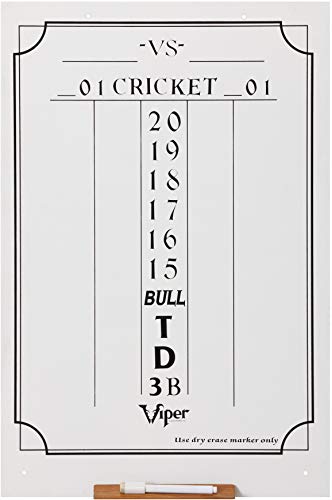
- Purpose-made layout tracks Cricket and 01 games at a glance
- Smooth surface works with any dry erase marker, and one comes included
- Mounting hardware is included for easy setup on a wall or cabinet door
Strategy: How to Win at 301
Get In Fast
The double-in rule decides more games than the finish does. Any double opens your account, so aim at one you hit consistently instead of automatically chasing double 20.
Plenty of players like the board's left side, where double 16 and double 8 sit close together — a near miss still threatens a double. Every turn your opponent is in and you're not, you're losing ground.
Score Hard in the Middle
Once you're in, treble 20 is the fastest way down. If your darts drift, treble 19 is a strong fallback with friendlier neighbors.
301 is short, so one hot turn can decide it. A 60-plus visit right after doubling in puts real pressure on.
Set Up Your Out
Plan the finish two turns early, and steer toward an even number — ideally 32, 16, or 8. Miss the double into the inside single and you're still left on a double.
That halving chain is the pro habit worth stealing: miss double 16 into single 16 and you're sitting on double 8. Our guide to 501 strategy covers the same checkout logic in depth, and it transfers straight to 301.
Common Mistakes
- Chasing treble 20 before you've doubled in — those darts score nothing.
- Ignoring your remaining score and busting on a careless big dart.
- Leaving odd numbers late, which burns an extra dart getting back to an even out.
- Rushing the double instead of treating it as the most important dart of the leg.
301 Quick Reference
- Start: 301 points, subtract every scoring turn.
- Open: hit any double before your points count.
- Finish: reach exactly zero, last dart in a double.
- Bust: score past zero, land on 1, or finish on a non-double — the turn is wiped.
Quick Answers
Is 301 faster than 501?
Usually — there are fewer points to burn through. But the double-in rule can stall a struggling player for turns on end, so a bad start drags games out; our 301 vs 501 comparison breaks down which suits your group.
Can you play 301 without doubling in?
Absolutely, and many casual players do. "Straight in, double out" is a common house rule that speeds the game up while beginners find their doubles.
Chalk up 301, agree on the double-in rule before the first dart, and let the doubles decide it.
301 vs 501: You're Playing the Wrong One
Double In vs Double Out: The Rule Flip