
301 vs 501: You're Playing the Wrong One
Same board, same darts, same chalk — the only fight is over the number that goes up top. One of you wants 301, the other swears real darts starts at 501, and neither of you is wrong.
Both games are countdown darts: start with a number, subtract every score, and finish on exactly zero with a double. The differences are smaller than the argument suggests, but they change how a night at the board feels.
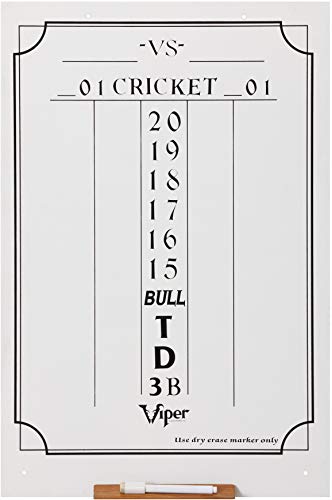
- Purpose-made layout tracks Cricket and 01 games at a glance
- Smooth surface works with any dry erase marker, and one comes included
- Mounting hardware is included for easy setup on a wall or cabinet door
The Core Difference
In 501 you start with 501 points and throw straight in — every dart counts from your first turn. You only need a double at the finish.
Traditional 301 starts you 200 points lower, but you must hit a double before any of your darts count. That "double in" rule is the real dividing line, not the starting number.
301 vs 501 at a Glance
- Starting score: 301 vs 501.
- Getting in: 301 requires a double first; 501 counts every dart from the start.
- Finishing: both end on exactly zero with a double.
- Leg length: 301 runs shorter on paper; 501 leaves room for a scoring phase.
- Skill it stresses: 301 leans on doubles at both ends; 501 rewards heavy treble scoring.
How Each Game Plays
501: The Standard
501 is what the professionals play on television, from the PDC World Darts Championship down to local league night. Legs are long enough for a real scoring phase, so consistent treble hitting gets rewarded.
Because everyone scores from dart one, nobody sits frozen at the start. Full details live in our 501 darts rules guide.
301: The Quick One
301 legs are shorter on paper, but the double-in rule bolts a skill gate onto the front door. A player who can't find a double can lose without scoring a point.
That makes 301 tense in a different way. Doubles matter at both ends of the leg, not just the finish — the full rules are in our guide to how to play 301.
Which Should You Play?
Pick 501 if...
- You're practicing for league or competitive play, since 501 is the standard format.
- Your group has beginners — nobody gets locked out by the double-in rule.
- You want longer legs with a scoring phase to groove your treble 20.
Pick 301 if...
- You want faster games, or you're squeezing darts into a short session.
- Everyone can hit doubles and you want them to matter more.
- The board is crowded and short legs keep the rotation moving.
Skills Each Game Builds
501 builds scoring power. More of the leg is spent pounding trebles, which is where matches are really won.
301 builds doubles under pressure. If finishing is the weak spot in your game, a few nights of double-in 301 is honest medicine.
Common Questions
Is 301 easier than 501?
Not really — it's shorter, but the double-in rule is harder on beginners than anything in 501. Straight-in 501 is usually the friendlier learning game.
Can you mix the rules?
House rules are everywhere: straight-in 301, double-in 501, even 701 for doubles teams. Just agree before the first dart goes up.
Why do pros play 501 and not 301?
501 gives a leg enough length to separate great scorers from good ones, and it starts everyone scoring immediately. That balance made it the professional standard.
Play 501 to learn the game, and keep 301 in your pocket for when the night needs a fast, doubles-heavy decider.
301 Darts: The Short Game With Sharp Teeth
501 Darts Rules: One Mistake Ends Your Leg