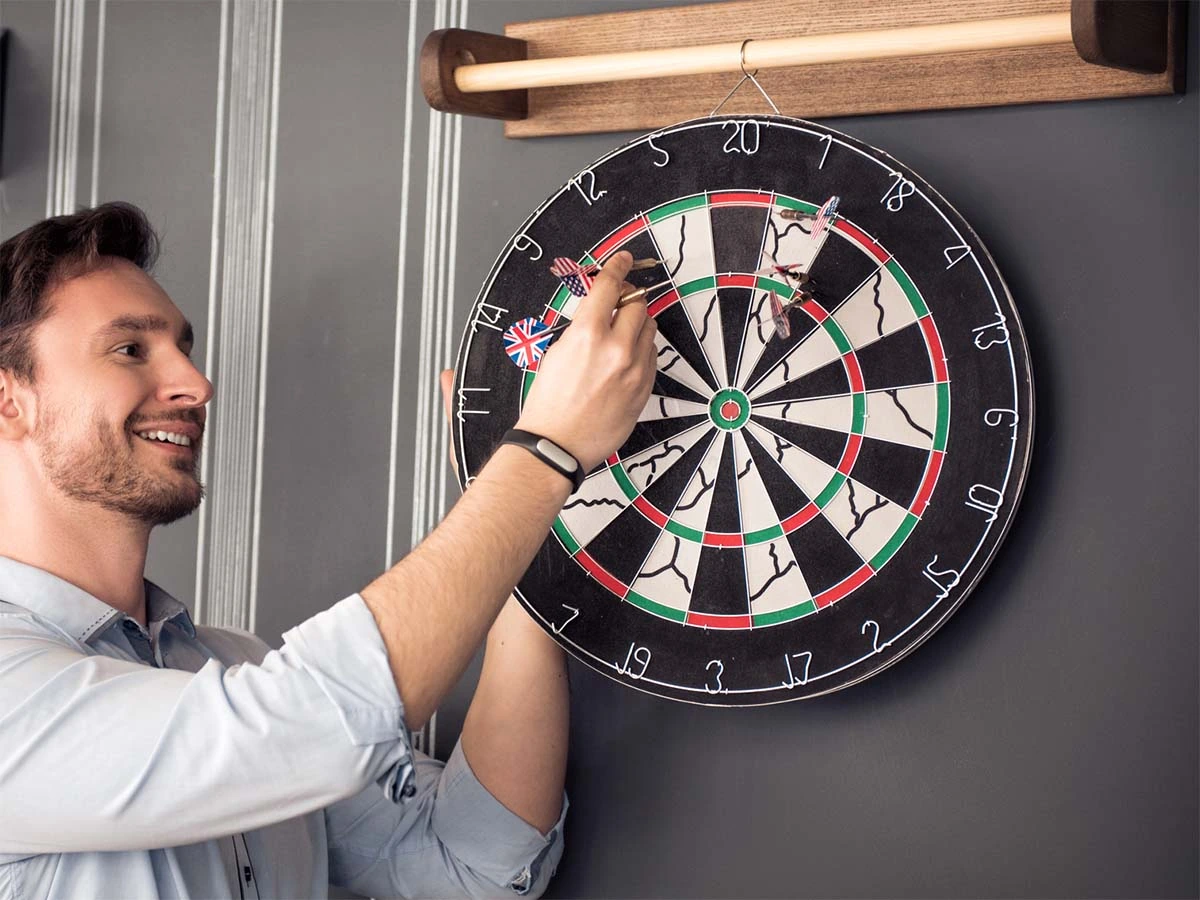
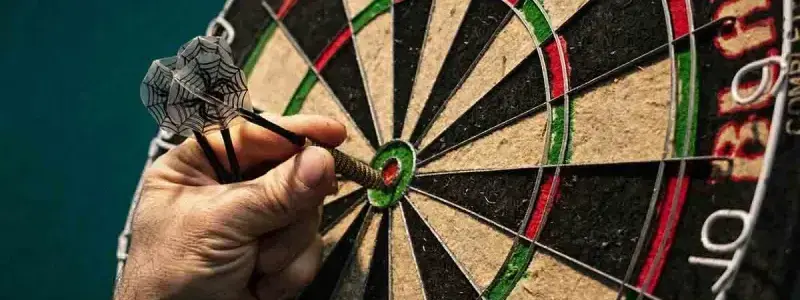
Bermuda Triangle: Where Scores Disappear
Eighty-six points sat safe on the chalkboard until the "any treble" round came up. Three misses later, the scorer draws a line through the 86 and writes 43.
That's Bermuda Triangle darts doing what it's named for — swallowing scores whole. It's a round-by-round target game with one vicious rule: miss the round's target with all three darts and your total gets cut in half.
What You Need
A standard dartboard, three darts per player, and a chalkboard with two things on it: the target sequence and everyone's running total. Any number can play, and it works brilliantly as a solo game.
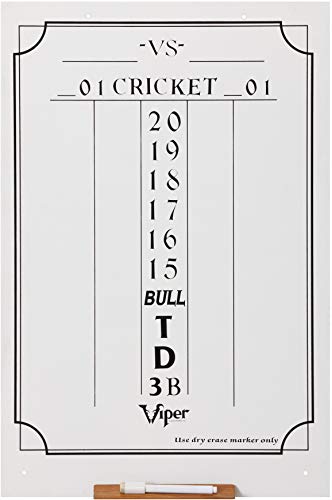
- Purpose-made layout tracks Cricket and 01 games at a glance
- Smooth surface works with any dry erase marker, and one comes included
- Mounting hardware is included for easy setup on a wall or cabinet door
The Rules
The game runs through a fixed sequence of targets, one per round. Each player throws three darts per round, at that round's target only.
Every dart that hits the target scores and gets added to your running total. If all three darts miss, your total is halved — rounding however your group agrees.
Highest score after the final round wins. There's no elimination, just the slow horror of watching your number shrink.
The Classic Sequence
A widely used 13-round sequence runs: 12, 13, 14, any double, 15, 16, 17, any treble, 18, 19, 20, any bullseye, and finally double bull. Chalk the list before you start so every round's target is public.
Groups vary the exact order and length. The pattern that matters is simple numbers building toward the killer rounds — doubles, trebles, and bull.
Scoring Details
On number rounds, singles, doubles, and trebles of that number all count at face value. Treble 14 in the 14 round banks 42, so trebles are where totals get built.
On the "any double" and "any treble" rounds, every qualifying hit counts its full value. On bull rounds, the outer bull scores 25 and the inner bull 50.
A Round in Action
Say you're carrying 60 into the 17 round. Dart one drifts into the 3, dart two lands single 17 — you're safe, and the board reads 77.
Dart three now gets a free swing at treble 17. Compare that with three misses: your 60 becomes 30, and two rounds of work evaporate.
Strategy
Survive First, Score Second
The halving rule means one safe dart beats three greedy misses. On dangerous rounds, use your first dart or two to guarantee a hit, then gamble the last.
It's the same risk management that runs Halve-It, this game's close relative. If you like one, you'll like the other.
Pick Fat Doubles
On the "any double" round, aim where you already practice. Double 20 and double 16 are the standards, and every rep transfers straight to your 501 finishing.
Bank Big on Easy Rounds
Rounds on 18, 19, and 20 are your scoring engine. Go treble hunting there, because the bull rounds at the end will tax whatever you're carrying.
Common Mistakes
- Treating every round the same instead of shifting between safe mode and score mode.
- Steering darts at the double ring instead of throwing a committed stroke.
- Forgetting the sequence and throwing at the wrong number — that's three dead darts.
- Sandbagging early; a small total halves painlessly, but you can't win on 40 points.
Is It Good Solo Practice?
One of the best games there is. It forces called-target accuracy under pressure, and it slots neatly into a rotation of solo darts practice games.
Bermuda Triangle vs. Halve-It
Same halving punishment, different flavor. Bermuda Triangle's sequence leans harder on doubles, trebles, and the bull — think of it as Halve-It's tougher sibling.
Chalk the sequence, protect your total on the ugly rounds, and stay out of the triangle.
Halve It: Miss Once, Lose Half Your Score

Shanghai: The Game With an Instant Win