
Bounce-Outs: Stop Blaming Luck, Fix Them
Clack. The dart that should've sealed your ton-eighty kisses the treble wire, hangs for half a heartbeat, then clatters to the floor and rolls under the table.
Bounce-outs cost you scores you already earned with a good throw. The fix is almost always one of three things: your points, your board, or your throwing angle.
Why Darts Bounce Out
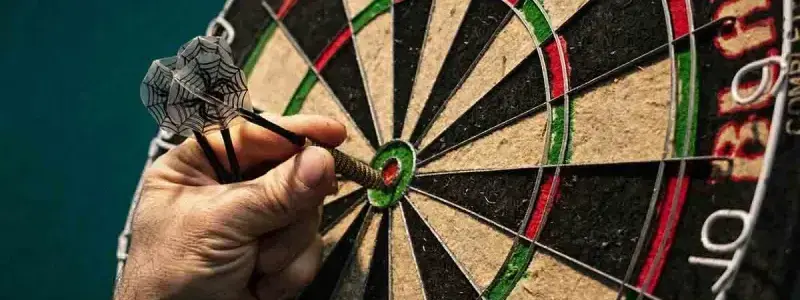
A dart bounces out when its point hits something it can't grip — usually a wire, a staple, or a patch of hardened sisal. Instead of sliding past and biting into the board, the point deflects and the dart's momentum throws it back at you.
Older boards make this worse, because their round wires and visible staples create more ricochet surfaces. Worn boards add hard, shiny patches where thousands of darts have compressed the fibers.
Fix Your Points First
Counterintuitively, a needle-sharp point causes bounce-outs. A too-sharp tip sticks into the wire itself instead of glancing off it and into the sisal.
You want a slightly rounded, textured point — think sharpened pencil that's written a page, not a fresh syringe. Work a dart sharpener in a circular motion to knock the needle tip off and add fine grooves; our guide to sharpening dart points walks through it.

- Keeps steel tips sharp so darts bite the board instead of bouncing out
- Five sharpeners cover your dart case, game room, and travel bag
- Small and light enough to carry to league night or the bar
Signs Your Points Need Work
- Shiny, polished tips that slide rather than bite.
- A flattened or hooked tip from hitting the floor.
- Burrs you can feel with a fingernail, which tear the board and weaken grip.
Upgrade or Rotate Your Board
If you're playing on a board with round wires and staples, a modern board eliminates most bounce-outs by design. Quality steel tip dartboards use thin, blade-style wires that deflect darts into the scoring bed instead of rejecting them.
Rotate your board regularly so the heavily hit segments around the 20 don't harden and wear. And if darts fall out of the board minutes after landing, the sisal is done — no technique will save it.
Adjust Your Throwing Angle
Darts that arrive flat or tail-down hit wires more often, because the point approaches the board at a shallow angle. A dart that lands slightly point-down slides past wires and buries itself in the fiber.
You don't need to reinvent your throw for this. A smooth arc with a full follow-through naturally delivers the point at a good angle, while a hard, flat "spear" throw invites the wire to reject it.
Do Heavier Darts Bounce Out Less?
Slightly, since extra mass carries the point through glancing contact with a wire. But weight won't rescue dull points or a dead board, so treat it as a marginal gain, not a cure.
Do Soft Tip Darts Bounce Out Too?
Yes, and for different reasons — flexible tips can miss the tiny holes in an electronic board's segments. Fresh tips and a firm, straight throw solve most of it.
Bounce-Out Prevention Checklist
- Round off needle points and re-texture them monthly.
- Replace hooked or flattened tips immediately.
- Rotate the board every week or two to even out wear.
- Retire boards with hard, shiny scoring beds.
- Keep your follow-through smooth so darts land slightly point-down.
Sharpen your points tonight — it's a two-minute job that saves more scores than any other fix on this list.
Sharpening Darts: You're Doing It Backwards
Dartboard Dying? Habits That Double Its Life