
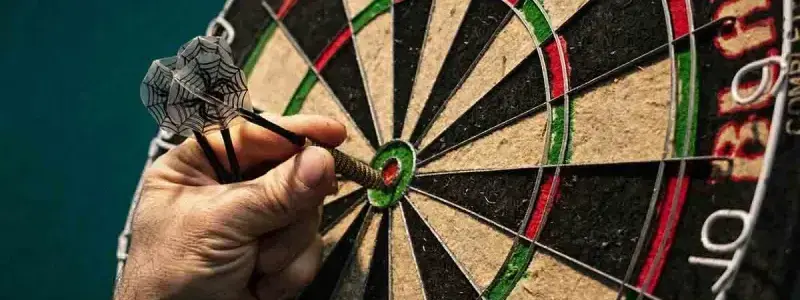
Bullseye Value: It's Less Than You Think
Your dart lands dead center and the whole bar erupts — for one glorious second, you feel unbeatable. Then your teammate checks the scoreboard and breaks the news: that famous red dot is worth 50 points, and it isn't even the best shot on the board.
The Short Answer: 50 or 25
The center of a dartboard has two scoring zones. The small red dot in the middle — the inner bullseye — is worth 50 points, and the green ring around it — the outer bull — is worth 25.
When players say "bullseye," they almost always mean the 50. It's a tiny target, too: the inner bull measures just 12.7 mm across, about the width of a fingernail.
Inner Bull vs. Outer Bull
The two zones go by several names, and knowing them helps you follow any game or broadcast:
- Inner bull (50 points): also called the double bull, the red bit, or simply "the bull."
- Outer bull (25 points): also called the single bull, the green bit, or "the 25."
The "double bull" name matters more than it sounds. In most rulebooks the inner bull officially counts as a double — double 25 — and that changes how games end.
Why the Bullseye Isn't the Highest Score
The best single-dart score is the treble 20, worth 60 points — ten more than the bull. That's why professionals fire at the top of the board, not the middle.
Three treble 20s score the famous maximum of 180. Three bullseyes score just 150, so chasing bulls actually costs you points over a full turn.
Finishing a Game on the Bull
In 501 and other double-out games, your last dart must land in a double. Because the inner bull counts as double 25, hitting it on exactly 50 wins the leg.
The outer bull is not a double, so it can never end a game. The bull also anchors the biggest possible finish in darts: 170, taken as treble 20, treble 20, bullseye.
The Bull-Off: One Throw for First Turn
The bullseye also decides who starts. Before a match, each player throws one dart at the middle, and the closest dart earns the first turn.
An inner bull beats an outer bull, and either beats a dart in the numbers. If both darts land in the same zone, players pull them and throw again.
The Bullseye in Cricket
In cricket darts, the bull is one of the seven targets you must close. The outer bull counts as one mark and the inner bull counts as two.
Once you've closed the bull and your opponent hasn't, every extra bull scores you 25 or 50 points. Close games often come down to who claims the middle first.
Soft-Tip Boards Score It Differently
Electronic boards don't all treat the center the same way. Some score it the traditional way — 25 outer, 50 inner — while many default to a "fat bull," where both zones score 50.

- 40 games and 315 variations keep league nights and family play fresh
- Tournament-quality target with automatic scoring takes the math out of the game
- Popular Cricket modes are built in for the formats players actually ask for
If you play soft-tip darts, check the machine's settings before the first leg, because leagues and tournaments specify which bull rule applies.
Next time you're sitting on 50, you'll know exactly what the middle is worth — aim for the red, not the green.