
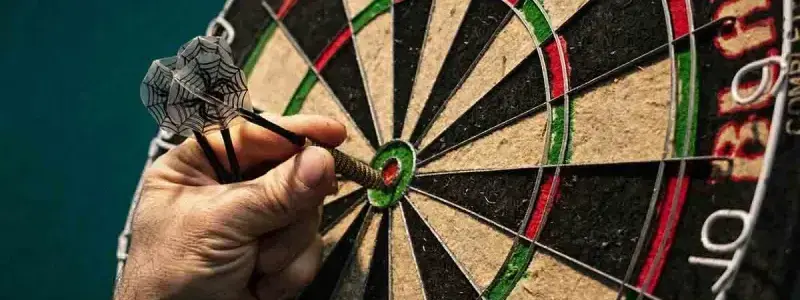
The Highest Single Dart: Not the Bullseye
Sixty points—the most you can score with a single dart—comes from hitting treble 20, not the bullseye. This razor-thin target near the top of the board turns one precise throw into darts’ biggest single-shot payoff.
How Dartboard Scoring Works
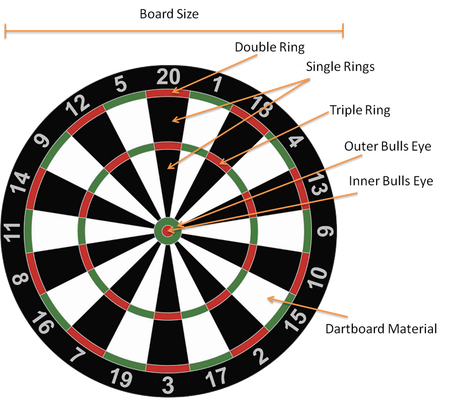
A standard dartboard is divided into 20 numbered sections arranged in an unforgiving order. High numbers sit beside low ones, so a small mistake can turn a strong throw into a weak score.
Most of each section scores the number printed beside it. Hit the broad area marked 20, for example, and you earn 20 points.
Two narrow rings increase those values. The outer ring doubles the number, while the inner ring triples it.

- Built to official tournament specifications for serious practice and match play
- Dual-density core improves dart retention and keeps the board playing consistently
- Ultra-thin wiring increases the scoring area and cuts down on bounce-outs
That inner ring creates the highest-scoring target on the board. Since 20 is the largest numbered section, hitting its treble area produces 60 points.
The next-best single-dart scores are close behind. Treble 19 is worth 57 points, treble 18 scores 54, and treble 17 delivers 51.
Why Treble 20 Beats the Bullseye
The bullseye may be the board’s most famous feature, but it is not the most valuable. The inner bull scores 50 points, while the outer bull scores 25.
This surprises many beginners because the center looks like the natural jackpot. In darts, however, the top-scoring target sits above the middle of the board.
Treble 20 is also much smaller than the main 20-point area. Hitting it takes control, consistency, and a repeatable throwing motion rather than raw power.
Missing by only a fraction can be costly. A dart that slips out of the treble ring may score just 20, while one that drifts sideways could land in the 1 or 5 sections.
That risky layout is part of what makes darts exciting. A player can aim for 60 and end up with a single point because nearby sections punish even a slight error.
In most competitive games, players throw three darts during each turn. Three treble 20s create a score of 180, the highest possible total in a standard three-dart visit.
A 180 is one of the sport’s most celebrated achievements. Landing three darts in such a tiny area demands exceptional accuracy and repeatable technique under pressure.
When the Highest Score Is Not the Best Choice
The biggest available score is not always the smartest target. Strategy changes as players work toward an exact finishing total.
In 501, each player begins with 501 points and subtracts the value of every throw. The goal is to reach exactly zero, usually by landing the final dart in a double.
Suppose a player has 40 points remaining. Aiming for double 20 ends the leg, while treble 20 would score too many points and cause a bust.
The inner bull can also finish a leg because it is worth 50 points and counts as a double. That gives the bullseye an important strategic role even though it cannot match treble 20.
Experienced players may switch targets when earlier darts block the treble 20 area. Treble 19 is a popular backup because it still offers 57 points and may provide a clearer route.
The maximum single-dart score is easy to remember: 60 points from treble 20. The real challenge is striking that tiny target when the pressure is on.
Related Questions
Why is treble 20 worth more than the bullseye?
Treble 20 multiplies the 20-point section by three, producing 60 points. The inner bull has a fixed value of 50, leaving it 10 points short.
What is the highest score with three darts?
The highest possible three-dart score is 180. A player must hit treble 20 with all three darts to achieve it.
Can one dart ever score more than 60 points?
Not on a standard dartboard using normal scoring rules. Specialty games or electronic systems may use different values, but traditional darts caps a single throw at 60.
How far away is the throwing line?
In steel-tip darts, the throwing line is 7 feet 9.25 inches from the face of the board. The center of the bull is normally positioned 5 feet 8 inches above the floor.
Bullseye Value: It's Less Than You Think
The Math Says You're Aiming at the Wrong Spot